As a Utah business owner with an online presence, you need to keep up with how search engines are changing. SEO determines whether you show up in local search results or disappear into page five. Businesses that understand these shifts and adjust their approach get more visibility and more customers than those that don’t.
Here’s what you should know about SEO in Utah in 2026, along with practical ways to implement these changes.

(rawpixel.com/Freepik)
User Intent Is More Important Than Ever
In recent years, Google’s understanding of user intent has improved significantly. The search engine can now understand why someone is searching and the result they’re trying to find. For example, it recognizes that someone searching “best roofing company in Salt Lake City” is probably ready to hire. Or that someone searching “how to repair a leaky roof” just wants to learn how to fix it themselves.
If you want to rank well, you need to match that intent in your content. Gone are the days of keyword stuffing in a generic blog post and hoping for the best. Now businesses need to write with purpose and give people the answers they’re looking for.
Think value-first content that improves your ranking while building trust with the audience.
Local SEO in Utah Is Heating Up
Whether you’re in Ogden, Provo, or downtown Salt Lake City, competition for local search visibility is rising. More businesses are optimizing for “near me” searches and claiming their Google Business Profiles. And Google is rewarding hyper-local relevance.
You need to make sure your business shows up not just in organic search but also in local packs and map listings. That means keeping your name, address, and phone consistent across directories.
If you’re focusing on Provo SEO, for example, your website should reflect that. Mention the city, reference nearby neighborhoods, and speak directly to local customers. If your site sounds like it could be based anywhere, you’re missing out on local traffic.
AI Content Detection Is Tightening Up
Artificial intelligence tools like ChatGPT have made it easier than ever to generate content. But just because you can doesn’t mean you should rely on it exclusively. Google is increasingly good at detecting thin, AI-generated content that lacks depth or originality. And while it doesn’t penalize AI content just for being AI, it does prioritize expertise, experience, authority, and trust (E-E-A-T).
What does that mean for you? If you’re using AI tools to help brainstorm or outline content, that’s fine. But don’t publish without adding your human insight. Speak to your real-life experience in your niche. Share data from your Utah-based business or testimonials from local customers. Those are the elements that prove to both Google and your readers that your content has substance.
Core Web Vitals Still Matter (More Than You Think)
Core Web Vitals are metrics that measure how fast and stable your site feels to users. Some examples of questions core web vitals answer include:
- How quickly does your main content load?
- How fast does your site respond when someone clicks a button?
- Does your page layout shift around while loading?
How do Core Web Vitals affect a local business? They influence your search rankings and whether people stay on your site long enough to take action. If your site is slow or unstable, visitors leave, and your rankings drop.
You can check your performance using Google PageSpeed Insights or Search Console. Both will show you what needs fixing. Common problems include large image files, too many plugins, and poorly coded themes.
Zero-Click Searches Are Stealing Attention
Not every Google search ends in a click anymore. With features like featured snippets, knowledge panels, and AI Overviews, users often get the answers they need directly on the search results page.
How can you make sure your Utah business shows up in these features? By structuring your content the way Google wants to see it:
- Use clear subheadings that match common search queries
- Answer questions directly in the first few sentences
- Include bullet points and numbered lists where they make sense
- Keep paragraphs short and scannable
This approach helps you land featured snippets and knowledge panel placements. Even when users do not click through to your site, they still see your brand name at the top of the results. Over time, that visibility builds recognition and trust.
Backlinks Still Work (But Not the Way You Think)
In recent years, the focus on backlinks has shifted from quantity to quality. Whether you run a roofing company in Provo or a law firm in Salt Lake City, you need links from reputable sites in your industry (or at least ones that relate to your location or service area).
For Utah businesses, you can try getting backlinks from local news outlets, Chamber of Commerce directories, and industry blogs. Try reaching out to journalists when you have something worth covering, like launching a new service or hosting a community event.
Another option is to create content that other sites naturally want to link to. Content assets like case studies and local data reports tend to attract backlinks because they provide real value to readers and serve as useful references for other writers.
Brand Signals and Consistency Are Crucial
Google wants to rank trusted businesses. That means you need consistent branding and a cohesive digital footprint. If your Utah business has outdated contact info on old directories or your website lacks HTTPS security, that inconsistency can chip away at your credibility.
Make sure everything from your logo to your metadata to your social profiles aligns. Even small things like updating your favicon (the icon next to your site’s name on a browser tab) or using structured data on your pages help build a stronger presence in search.
How to Stay Ahead in Utah’s Competitive SEO Landscape
SEO isn’t a one-and-done task. If you want your business to rank well in Utah’s evolving search landscape, you need to:
- Monitor updates to Google’s algorithms
- Regularly review and improve your site’s technical health
- Create helpful, original content that reflects your real-world expertise
At the end of the day, your goal is to show both Google and your audience that you deserve to be seen. Not by cutting corners, but by adding value.
The challenge is that doing this on your own takes time and technical knowledge. Between running your business and keeping up with algorithm changes, most business owners do not have the bandwidth to do SEO well consistently.
That is where working with an SEO agency in Utah can make a difference. An experienced team like SEO National can handle the technical work and build a strategy that fits your business goals.
Utah’s digital economy is only growing. Whether you’re based in Salt Lake, Lehi, or Logan, prioritizing SEO now will put you on the path to better visibility and more customers down the line.
Video

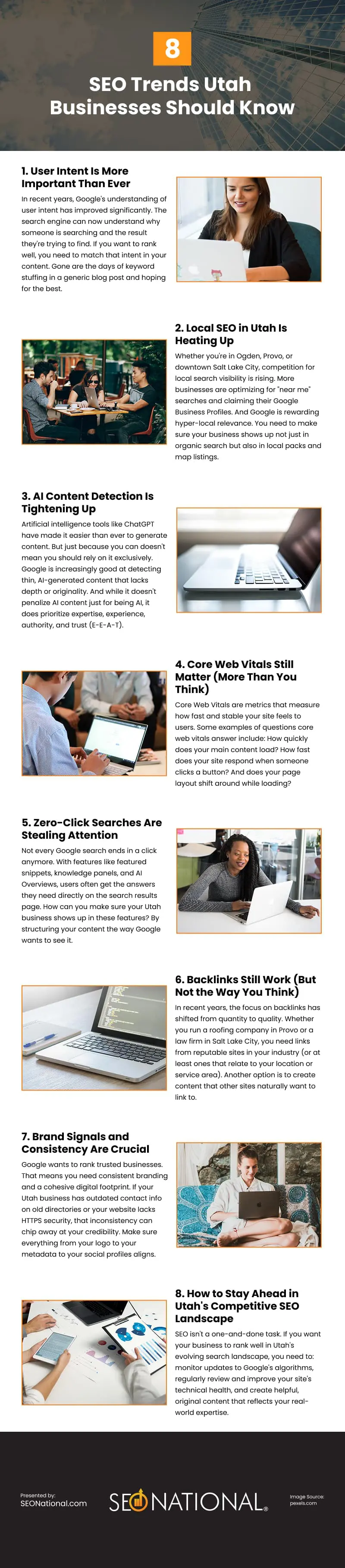
Infographic
Search engine optimization in Utah is evolving rapidly, and businesses that want to stay visible in 2026 must adapt to Google’s latest standards for relevance, trust, and user experience. Check out this infographic to learn the key SEO trends Utah businesses need to know.